
Monitor · Predict · Self-heal
Infrastructure intelligence for every website, Windows server, Linux server and Fibre Network Infrastructure.
GSS Network Intelligence combines website monitoring, Windows and Linux endpoint agents, Fibre Network Infrastructure monitoring, predictive analytics and AI operations into one command center.
Devices
240
Websites
1,287
Predictions
42
Recovered
99.8%
Web server memory rising continuously
G1-360M recommends restarting the registered service.
Inside the command center
See the health of your infrastructure at a glance.
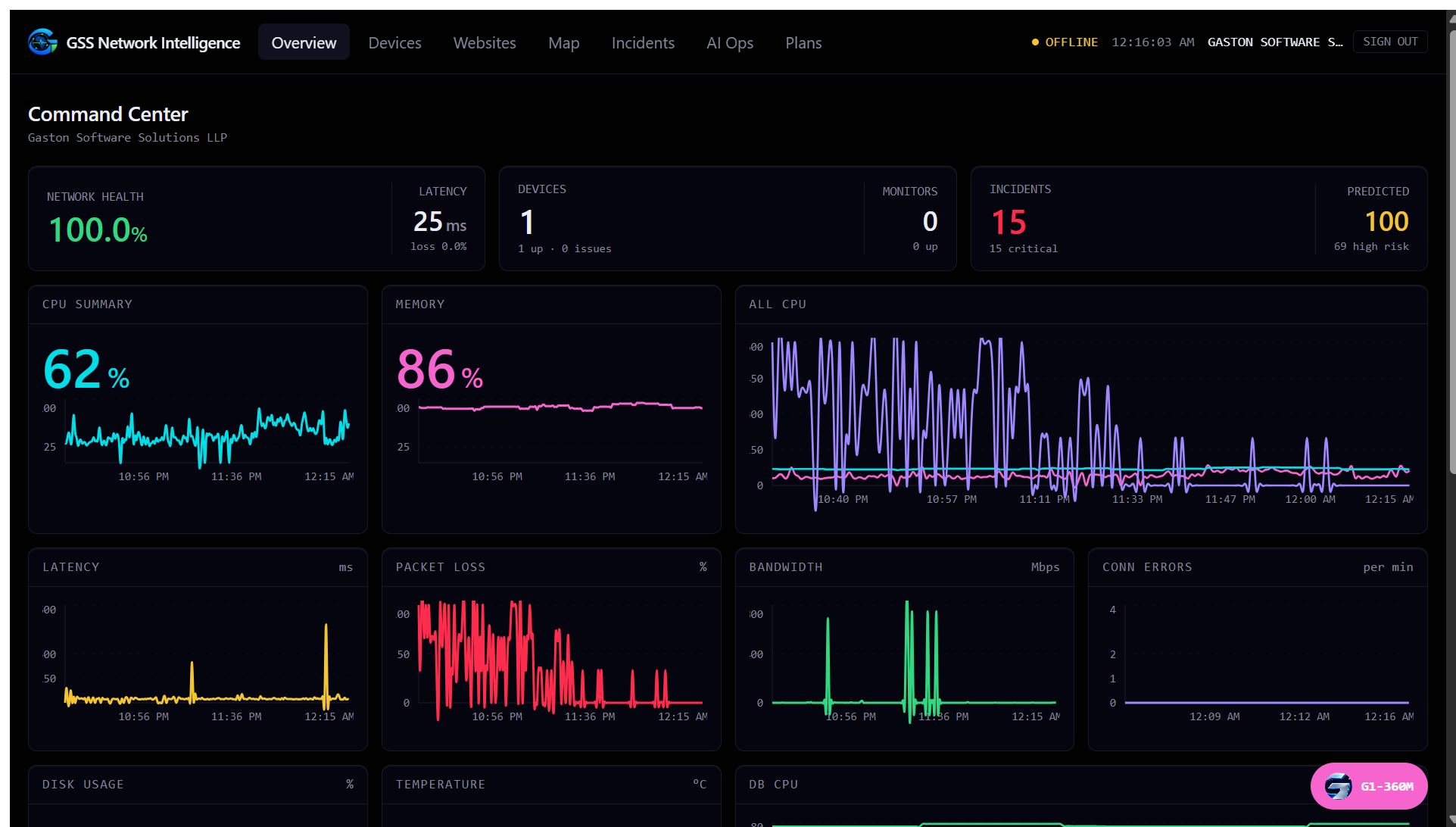
The GSS overview brings live device telemetry, website checks, incidents and predicted risks into one clear workspace. Follow CPU, memory, latency, packet loss, bandwidth, storage and temperature trends, then move from a signal to an AI-assisted recovery action without changing tools.
What GSS does
Website monitoring
Ping, HTTP, HTTPS, DNS, SSL, latency and packet-loss checks from the cloud.
GSS Windows Agent
CPU, RAM, disk, network, services, processes and local connectivity from each machine.
GSS Linux Agent
A lightweight systemd service for Linux servers with CPU, memory, disk, network, heartbeat and secure telemetry reporting.
Fibre Network Infrastructure
Monitor routers, switches, firewalls, OLTs, splitters, ONTs, links, traffic, health and connected customer devices through GSS Agents or agentless SNMP, REST, SSH and ICMP integrations.
AI operations
G1-360M explains incidents, predicts outages, recommends actions and verifies recovery.
Virtual Fibre Network Lab
Test a complete fibre network before touching production.
GSS includes a local Electron simulator for engineers and network operators. Build a realistic topology with routers, switches, firewalls, OLTs, splitters, ONTs/CPEs, servers and customer devices, then watch traffic, interfaces, health and failures move through the network in real time.
Model the infrastructure
Create branches and centres, assign IP and MAC identities, connect links, inspect interfaces, routes, VLANs, firewall state, neighbours and device events.
Exercise real failure paths
Generate traffic across every link, disconnect a router or access device, and verify that only the affected downstream branch loses reachability.
Send one complete snapshot
The local server exposes a management API and can send the full device, link, telemetry and location inventory to GSS-CLOUD for maps, graphs, incidents and AI diagnosis.
One intelligence platform
Use the simulator as a safe baseline for the same Network Intelligence workflows used with GSS Windows Agents, GSS Linux Agents and agentless Fibre integrations. Engineers can clone and adapt the open lab baseline for their approved use case.
Global monitoring fabric
Every website is assigned global coverage.
When a visitor adds a website, GSS registers it in GSS-CLOUD, selects suitable probes from our 65 global monitoring servers, and stores its monitoring history in the protected GSS distributed file system. Results are correlated into one map and incident timeline.
65 global servers
Distributed probes run ping, HTTP, DNS and SSL checks from multiple regions.
Automatic assignment
Each website is mapped to probe locations for resilient global visibility and fast failover.
Centralized history
Checks, latency, packet loss and recovery events are retained for trend and incident analysis.
GSS-CLOUD alerts
Organizations configure recipients, severity thresholds, escalation order and notification quotas from the operations platform.
Trusted agent security
GSS-CLOUD verifies every agent.
During enrollment, each agent receives a unique certificate credential. Every heartbeat, telemetry packet, command and update request is checked against its registered identity, organization and certificate hash. Missing, expired, revoked or mismatched credentials are rejected before they reach the platform.
1. Certificate identity
The agent keeps its private credential locally; GSS-CLOUD stores only the verification record.
2. Verified updates
Agents check the signed update manifest, compare the release version and verify the download before recommending installation.
3. Malware resistance
HTTPS transport, certificate checks, checksums, allowlisted commands and least-privilege service policies reduce malicious-code and impersonation risk.
Install in minutes
How the GSS Agent works
01
Download
Download the GSS Agent for Windows PCs, Windows Server, or Linux.
Linux install: create an agent folder, place the downloaded file inside it, then run:
mkdir -p ~/gss-agent
cd ~/gss-agent
chmod +x GSSAgent
sudo ./GSSAgent
02
Sign in
Run the installer and enter your GSS account email and password once.
03
Connect
The agent receives a unique identity, registers the device and installs as a Windows Service or Linux systemd service.
04
Protect
It sends heartbeats and buffered telemetry, retries after outages and executes approved remediation.
Your password is never stored by the agent. Windows credentials use DPAPI; Linux credentials are protected by root-only file permissions. Telemetry is sent over HTTPS and commands are limited to approved actions.
Know before your infrastructure fails.
Start with a 30-day free trial.